Friday, May 17, 2024

On my way to Anatolia (2)


Caspar David Friedrich: Infinite Landscapes
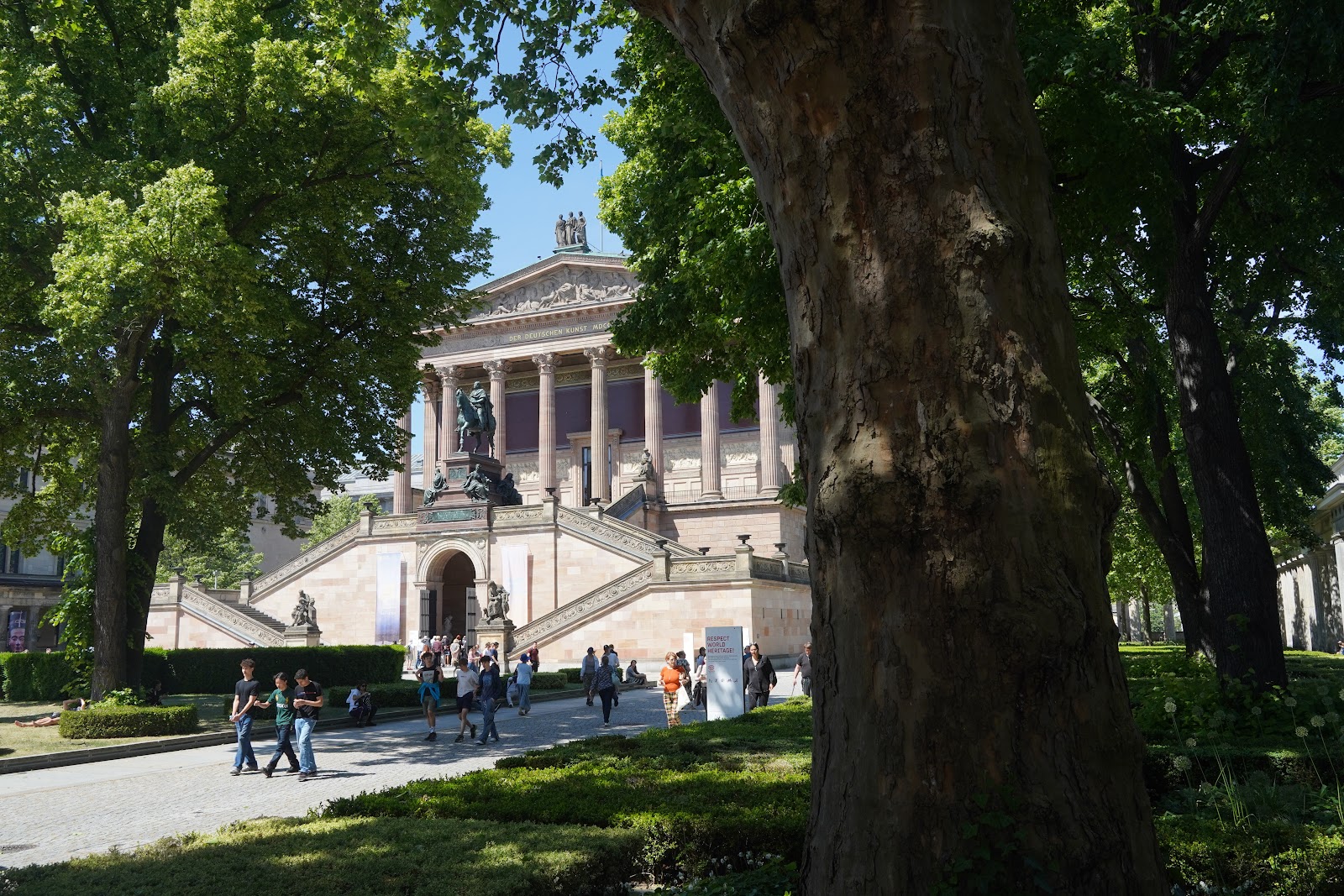

There is a second reason I why I wanted to come to Berlin. The old National Gallery houses a big temporary exposition of the romantic German Painter Caspar David Friedrich.
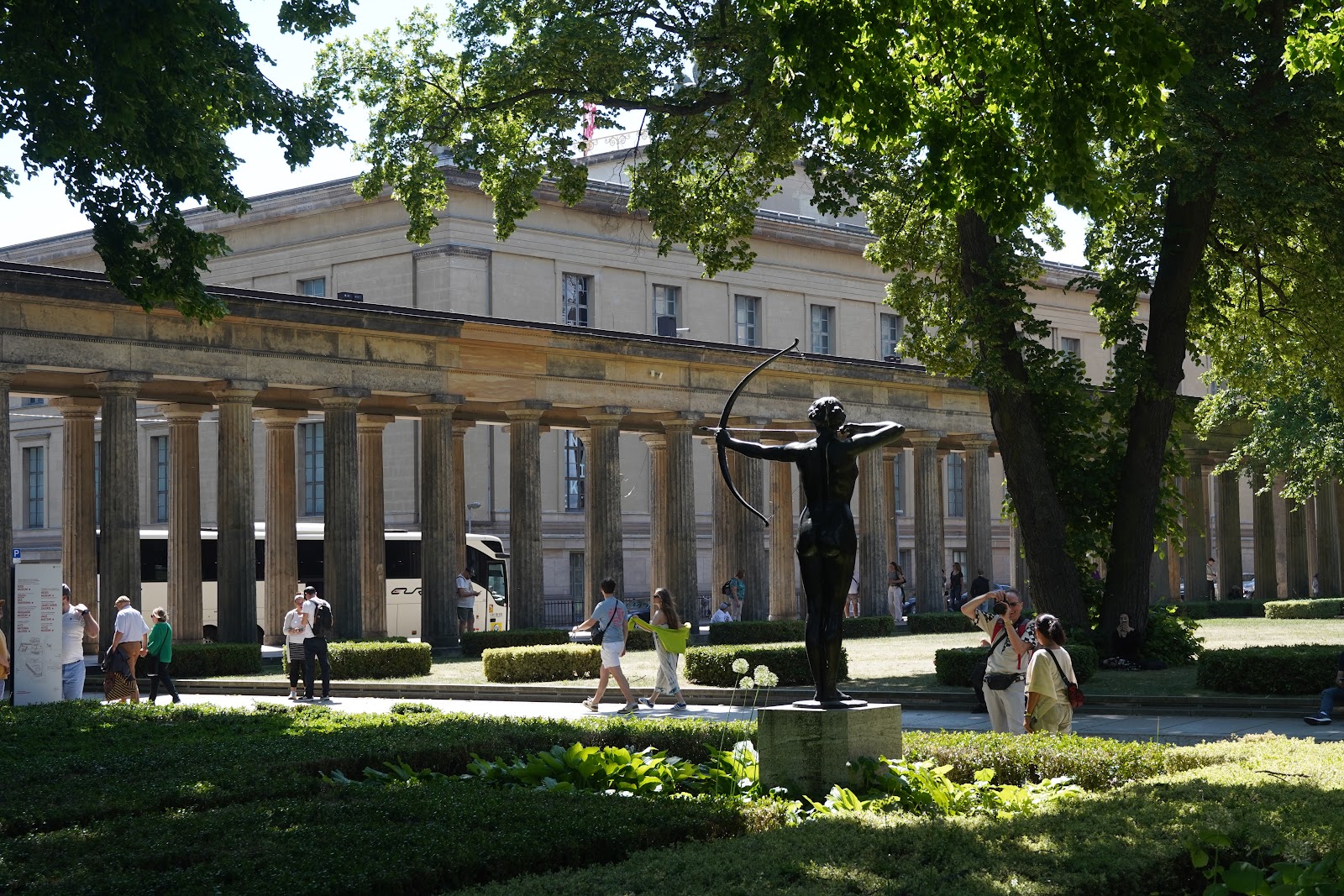

The Kolonnadenhof around the gallery

In the conglomerate of a multitude of different little states, kingdoms and duchies of imperial Germany before 1918 Prussia played the leading role and long before Berlin became an imperial capital it was the capital of Prussia. Like the other sovereigns of monarchist European states the kings of Prussia, later becoming the Emperors of the German Reich, were eager to collect and show off with their works of art.

So in the second half of the 19th century the Prussian king Frederick William IV got the architect Friederich August Stühler to built the Alte Nationalgallerie. Together with the Altes Museum, the Neues Museum, the Bode Museum, the Pergamon Museum, the Berlin Cathedral and the Lustgtarten it forms the Museum Island complex. The UNESCO declared it a world heritage site.


Portrait of Caspar David Friedrich by Carl Johan Baehr

The basic collection of the National Gallery was formed in 1861 by a donation of 262 works collected by the banker Johann Heinrich Wagener. Part of it were a number of paintings of the romantic painter Caspar David Friedrich. Friedrich, born in 1774 in the northern coastal town of Greifswald, studied painting at the academy in danish Copenhagen. However, after his studies he moved to Dresden in Saxonia. He lived there for the rest of his life, but returned to his native land frequently for long periods of time.


Portrait of Caspar David Friedrich by Caroline Bardua

The national gallery sells half of the tickets available for the day online. With the e-ticket you can avoid the lines at the counter and get in immediately during your time slot. Unfortunately, when I finally decided on the day that I intended to visit, the online tickets were sold out. It seemed to be a very popular exhibition, so I was afraid that I would come to Berlin and either have to wait in a line for a long time or not being able to get in at all. They have already extended their daily opening hours and open an hour early at 9 am.
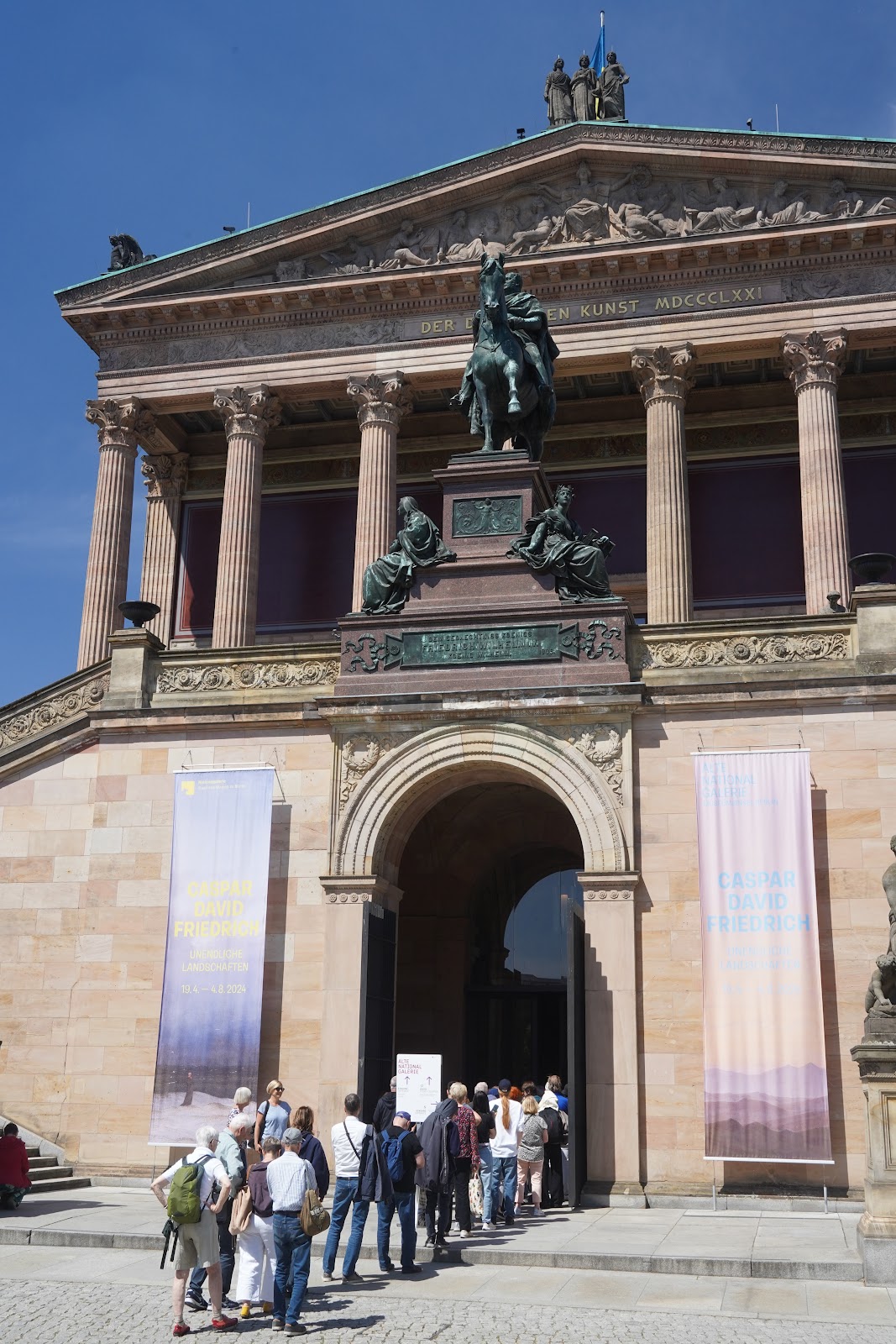

So in my zeal to get a ticket I get up early and walk to the gallery where I arrive just a couple of minutes after 9. There is a line at the entrance and being an obedient citizen I join at the end. When I ask the lady in front of me she acknowledges that this is the line for people without a prebooked ticket.


Having made sure my place in the queue I look around. There are several gates. The sign above the one of my line says “e-tickets”. Above the next gate, where nobody is waiting, it says “Tageskasse”. So I am in the wrong queue. For people like me, who do not have a pre-booked ticket, there is no queue at all, neither outside nor inside. They also provide an excellent audio guide for free and it is not overcrowded like on similar occasions elsewhere.


Caspar David Friedrich was a landscape painter. There are very few works where a living soul is the main object. His paintings seem to portrait a lost world. Today, in landscape photography, photographers are in a permanent urge of finding the perfect landscape. But the modern landscape is getting increasingly ugly. Trees are dying. Rivers and lakes have artificial beds and shores..There is always a building, a power line, a windmill or some development in the way. In Friedrichs paintings the landscape is perfect, empty. There are no distractions.


Böhmische Landschaft mit dem Mitteschauer 1808

However, most of his landscapes are fantasy objects. They are constructed to convey a message or a feeling. Friedrich contemptuously called painters who created an exact depiction of the landscape “Landschaftsschreiber” landscape writers. “Sieht er nichts in sich dann soll er nicht malen was er vor sich sieht” (If he doesn’t see anything in himself, then he shouldn’t paint what he sees in front of him), Friedrich is said to have once said.


Caspar David Friedrich never saw the Watzmann, a peak in the Alps. He copied it1824/1825 from somebody elses drawing 

If Friedrich paints a mountain, than the mountain is a symbol for the power and the beauty of nature. It is the contrary to what you see these days from the window of a moving train: in the landscapes of our time mountains and rivers have lost their power and have become a victim in the shade of development.
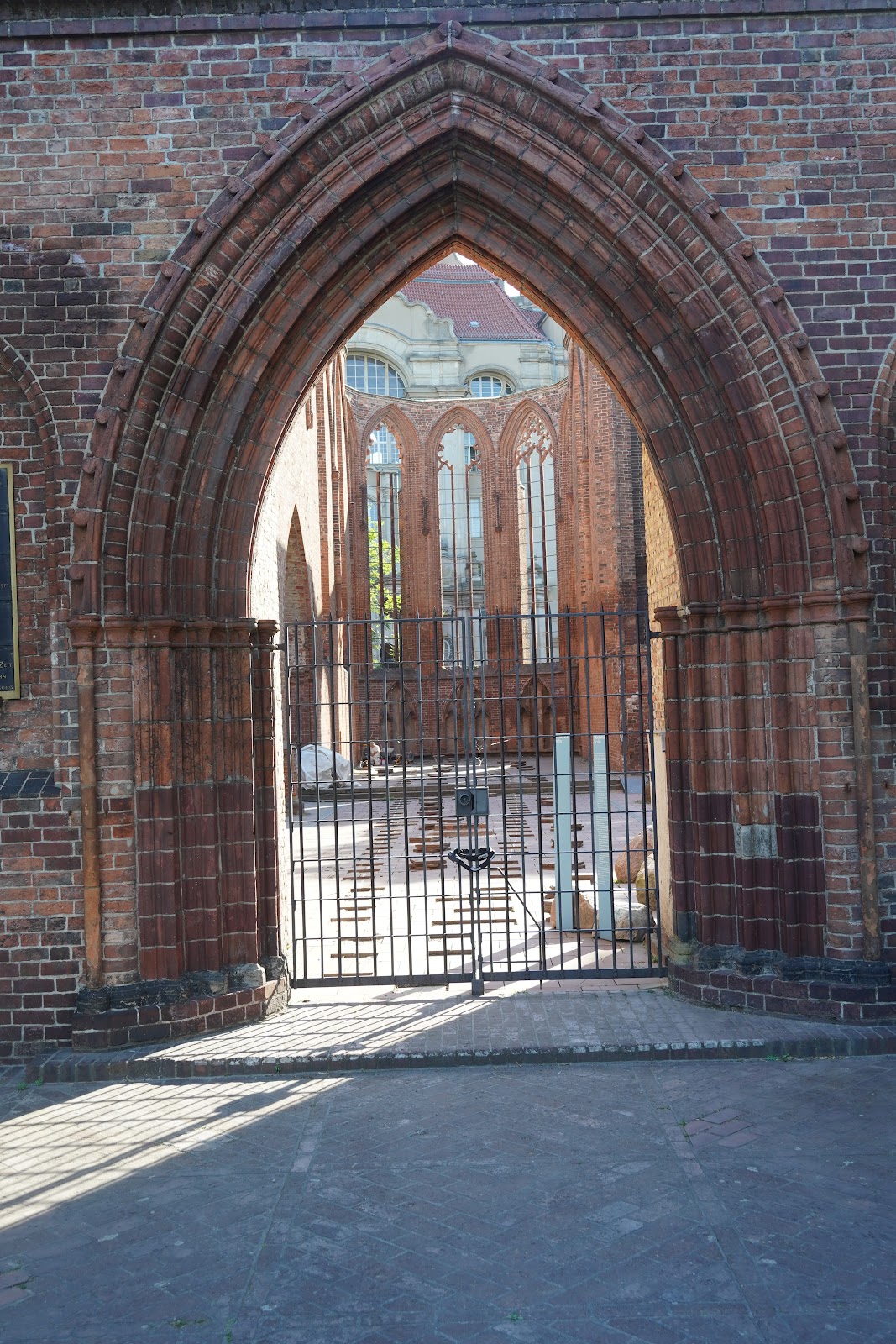
The ruin of the church of the Franziscan Monastery in Berlin would have inspired Caspar David Friedrich

In the romantic era of Friedrich’s paintings the appreciation of the German ruin started: Friedrich made exact drawings of Oybin castle near Zittau in Saxonia or the Monastery ruins of Edena close to his native town of Greifswald. In his paintings they never are simply depicted in their actual surrounding. He always copies the drawings into a setting tailored to convey his message.


Painting of the ruin of the church of Eldena monastyery close to Greifswald, 1825


Friedhofstor 1830

If you see a Friedrich painting with a couple of ships close to shore, in the evening with the sails ready to fall, and there is a couple of playing children, a young couple and an old man on the shore watching the scene, than this is not a simple romantic picture of a harbor. It is a symbol for life, where the old man looks back at his experiences while the cycle of life starts again with the playing children.


Lebensstufen 1834

Friedrich loved to walk. Alone or with friends he did long hikes in the mountains around his home town of Dresden, in northern Germany such as on the island of Rügen or in the Riesengebirge in Silesia. During the hikes he meticulously made drawings of trees, rocks, buildings, boats or mountains. On these drawings he not only noted the date but also the time it took him to make the drawing. To complete the drawing of a fir tree could take him more than 5 hours. At home, he arranged motifs from these drawings into the pictures. The people in his landscapes to accentuate the feelings were usually small, and frequently shown from behind. Friedrich had a selection of model drawings of figures, which he traced into the sets using powder coated oil paper.


Distel and Baumstudien 1799


Studien zu Booten, 1806


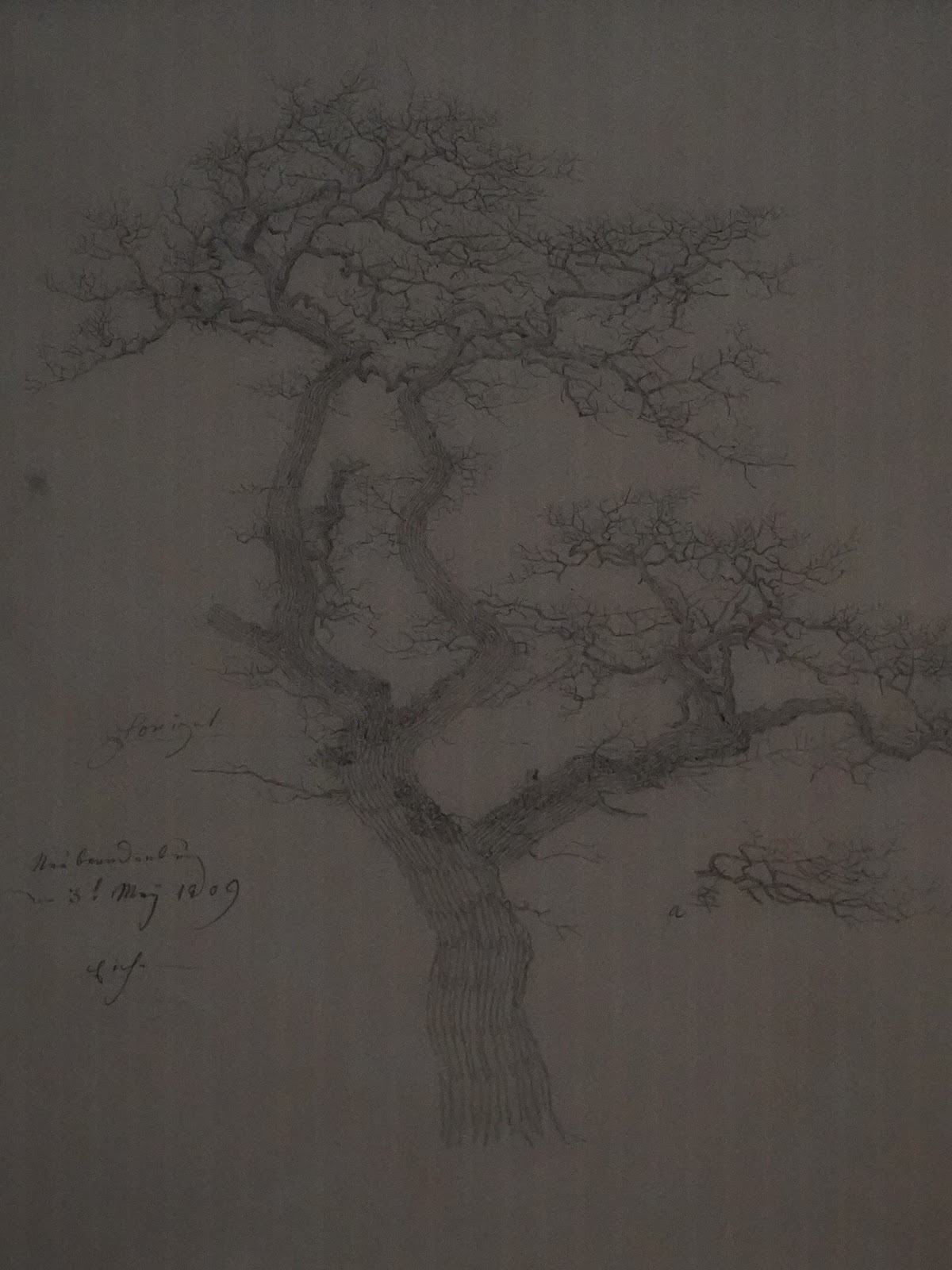
Entlaubte Eiche 1809


Eichbaum im Schnee

Pictures not only can show things but they can also hide. In today’s world unwanted objects can be removed from photos by photoshop. Friedrich went a step further: he only selected the parts he wanted and put them together to create an entirely new design. This process was repeated by Hiroyuki Masuyama. He copy and pasted parts from photographs together to get almost perfect large scale copies of famous Casper David Friedrich Paintings. These new copies are transparent and illuminated from behind.


Hiroyuki Masuyama nach Caspar David Friedrich, Mondaufgang am Meer, 2018


Mondaufgang am Meer 1822

In a couple of paintings Friedrich painted his home town of Greifswald in an empty landscape. Coming from the emptiness the homliness of the town offers a rewarding welcome for the wanderer. In one painting the town of Neubrandenburg is consumed by a devastating fire. There was no fire in Neubrandenburg in Friedrich’s time. The town serves as a symbol.


Wiesen bei Greifswald, 1821/1822


Das brennende Neubarndenburg, 1834

One of Friedrichs favorites was the island of Rügen. He crisscrossed it on his walks. What would he do there today? Would he still paint a monk on an empty beach when there is no empty beach any more? When the blast of sound follows him to the remotest corners in the middle of the night? Would he like to walk in the Erzgebirge when his steps are followed by the constant roar of motorcycles on the road in the distance or of fellow hikers blasting their music into what is left of the emptiness?


Zwei Männer in Betrachtung des Mondes, 1830/1835

Surrounded by barren trees two men watch the moon at night. You can sense the silence around them. What might be their thoughts? Imagine that: do you know anybody who goes out with a friend to watch the moon? In our present world, where development is the measure of things, where can we find a space which is so empty, quiet and undisturbed that you can watch the moon with a friend? There always is the sound of an airplane, there is the noise of traffic, distant lights and electric stars.


Georg Friedrich Kersting, Caspar David Friedrich in seinem Atelier, 1812

Caspar David Friedrich died in poverty in 1840. In his last years he barely was able to feed his family of three children. After his death his art became all but forgotten. With the bequest of Wagener, the National Gallery in Berlin got into the possession of several of his paintings. In 1906 the Museum held the “Deutsche Jahrhundertausstellung” (German Centennial Exhibition) representing Friedrich with 93 paintings and drawings. This brought his romantic view of thoughtful silhouettes meditating in empty spaces, in front of ruined buildings or under mighty mountains, back into the lamplight. Did the dead trees surrounding his characters not predict the dead forests of our time?


Bust and Portrait of Caspar David Friedrich 

How much free space do people need? The space which is willingfully assigned to development, business, infrastructure or pleasure is readily distributed. Even the sky is taken. And in the few cases where there are reserves, their access is limited. There is no space for uselessness, emptiness.


Riesengebirgslandschaft mit aufsteigendem Nebel 1819/1820

In his time Friedrich’s paintings created a lot of discussion. It was not only a new way of painting but also of looking. “es ist als würden einem die Augenlider weggeschnitten” (it's like having your eyelids cut away) the German romantic poet Heinrich von Kleist wrote when he first saw Friedrich’s painting “Mönch am Meer”. I think today Friedrich’s paintings should motivate us to see landscape as a valuable asset, worthwhile to protect from the profiteers keen on cheap development. People do not only need beauty and aesthetics in a museum. It should be a protected part of everyday life. Quiet spaces should not only exist in artificial quiet rooms or meditation centers, but should be part of life and of protected areas.


Das Eismeer, 1823/1824 

Source:
Audioguide to the exhibition
Caspar David Friedrich, Unendliche Landschaften, Nationalgallerie, Katalog, 2024

Link to the previous post:

Thursday, May 16, 2024

On my way to Anatolia (1)


Divided City, divided Europe


I am on my way to Anatolia, … by interrail. Maybe I should not tell beforehand. Because, I might never actually get there. But if I publicly announce my intention there is a higher chance that I actually try to do it. For sure, somebody will blame me for showing off if I was not there.


Deventer station, Netherlands

There are two reasons which actually make it highly improbable that I will never make it. First, yes, from central Europe it is a very long way. Google tells me that it is 4111 km by road to what a traveler's report calls “the grim garrison town” of Kars not far from the eastern Turkish border with Armenia and Georgia. That is about the eastern most point you can get to with an interrail ticket. In comparison, west it is only 2240 km to Lisbon, 2578 km south to Agrigento, or 2871 north to Narvik. Said so, there is the Optima express from Villach to Edirne. Presently, it is the closest you get to the famous Orient Express. It takes two nights and one day. If it is on time, but that is probably not important anyway. And then, from Ankara, it is another 26 hours by night train to Kars.


Changing trains in Hengelo, Netherlands

But a night train is a night train which means is runs at night. Not so much to see, only dreams, if you manage to sleep. That is how we get to the second point. Check out all those interesting places on the way. Eastern Europe always has been a borderland. All those civilizations fighting for the land have left their traces. And those madmen, without learning from history, still fight. The 50 years of communism in those countries between Central Europe and Turkey have added an additional modern aspect. Breaking down the trip into short bits will make it more fascinating, but also time consuming.


Stop in the German border station Bad Bentheim

Nowhere else in Europe was the division of Europe into a communist and a capitalist block more imminent, more dangerous and more clashing than in Berlin. So why not go there for the beginning? It brings me 667 km to the east. Another 3631 km to go from there.


Osnabrück, Germany, lower platforms

It is easy to go to Berlin. Only one change of trains for me. The paramilitary dutch conductors don’t show up to check my ticket. Deutsche Bahn is almost on time. It looks like they try to do their best to get back my support.

One of the many ruined stations on the route in Germany

This probably is one of the most uninspiring main line train trips in Europe. More than 600 km of flat, raped countryside. In Germany, the railway buildings are in ruin, tracks overgrown with weeds. Ugliness and neglect everywhere. Modern construction inspired by fast money making dominates the silhouettes of the settlements. Parking lots, distribution centers, retail markets, … planning made by people who have lost any contact to aesthetics. Fortunately, over long stretches they have placed sound barriers on both sides of the track so high that it is now made impossible to see such insults for the eye as Bad Oeynhausen and similar towns along the route. And then my destination is Berlin, the culmination of the aesthetic mayhem created by two competing regimes.


Ruins of the former engine shed, Hannover Hbf

Only about half an hour after the stop in Hannover the countryside changes. The train runs fast across the empty, serene landscape of Brandenburg. The eye wanders over vast fields carrying the fresh green of spring, surrounding the odd lonely tree, separated by hedges and interspersed with little forests. So far this area was too poor and too remote to attract the profiteers. The few little villages and towns appear empty, old brick buildings and little concrete. There are sound barriers here too, but they are low, and overgrown by weeds in a way that they are almost incorporated in the scenery.


The flat open spaces of Brandenburg


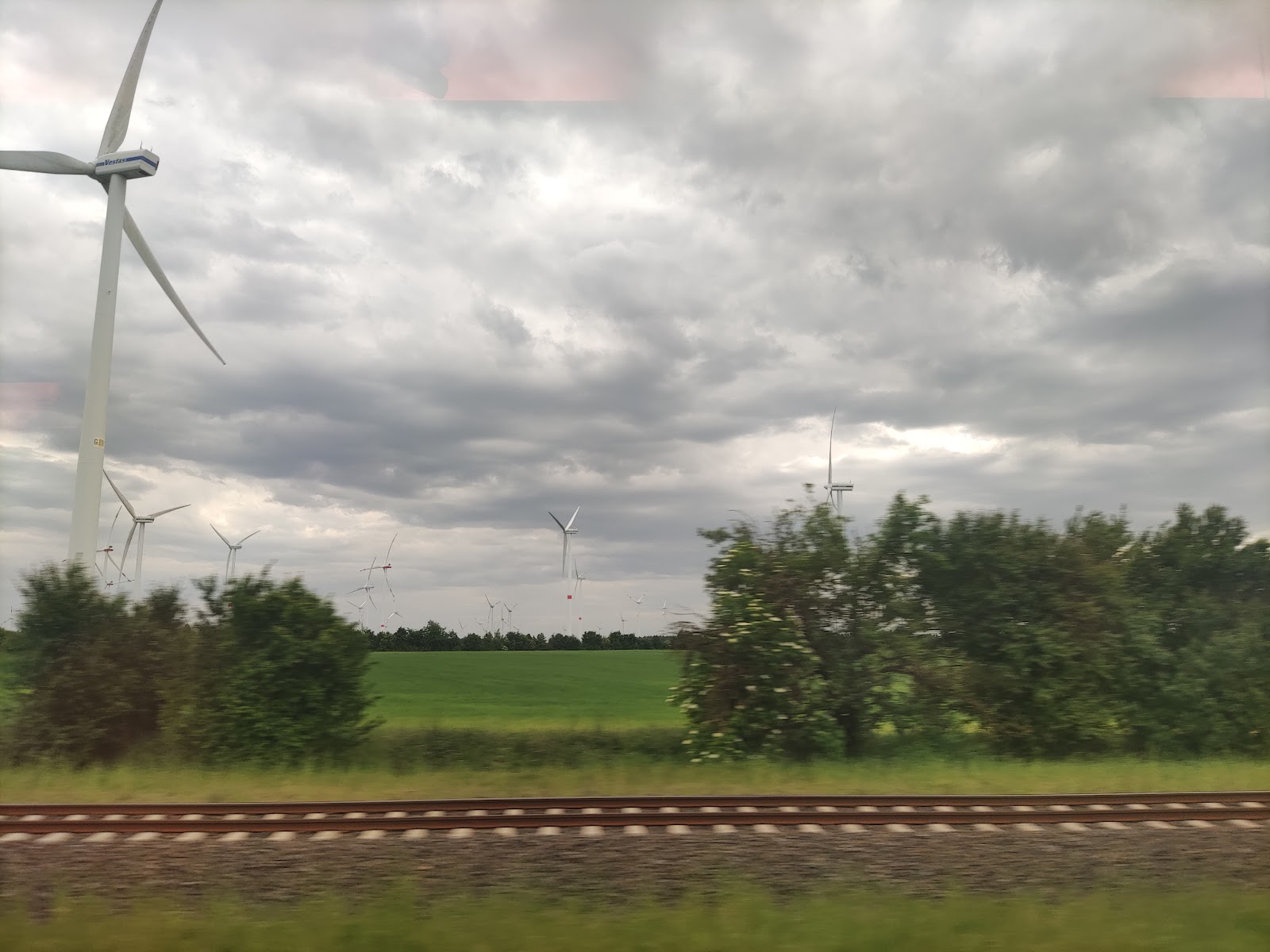
But modern times are around the corner. The empty spaces are inviting for the placement of windmills, the vast fields offer space for solar fields. Emptiness has had its longest time.


The train brings me from a rainy morning in the Netherlands to a sunny spring afternoon in Berlin. My opinion of Berlin is not very high. A wild mixture of different building styles. Lots of traffic. In the ranking of friendliness towards visitors and politeness among European capitals not at the bottom, but almost. Hence, what a surprise. When I leave the long distance train in Hauptbahnhof and change into a crowded S-Bahn, a friendly young lady actually offers her seat. For Berlin, that is unheard of. Totally unexpected.

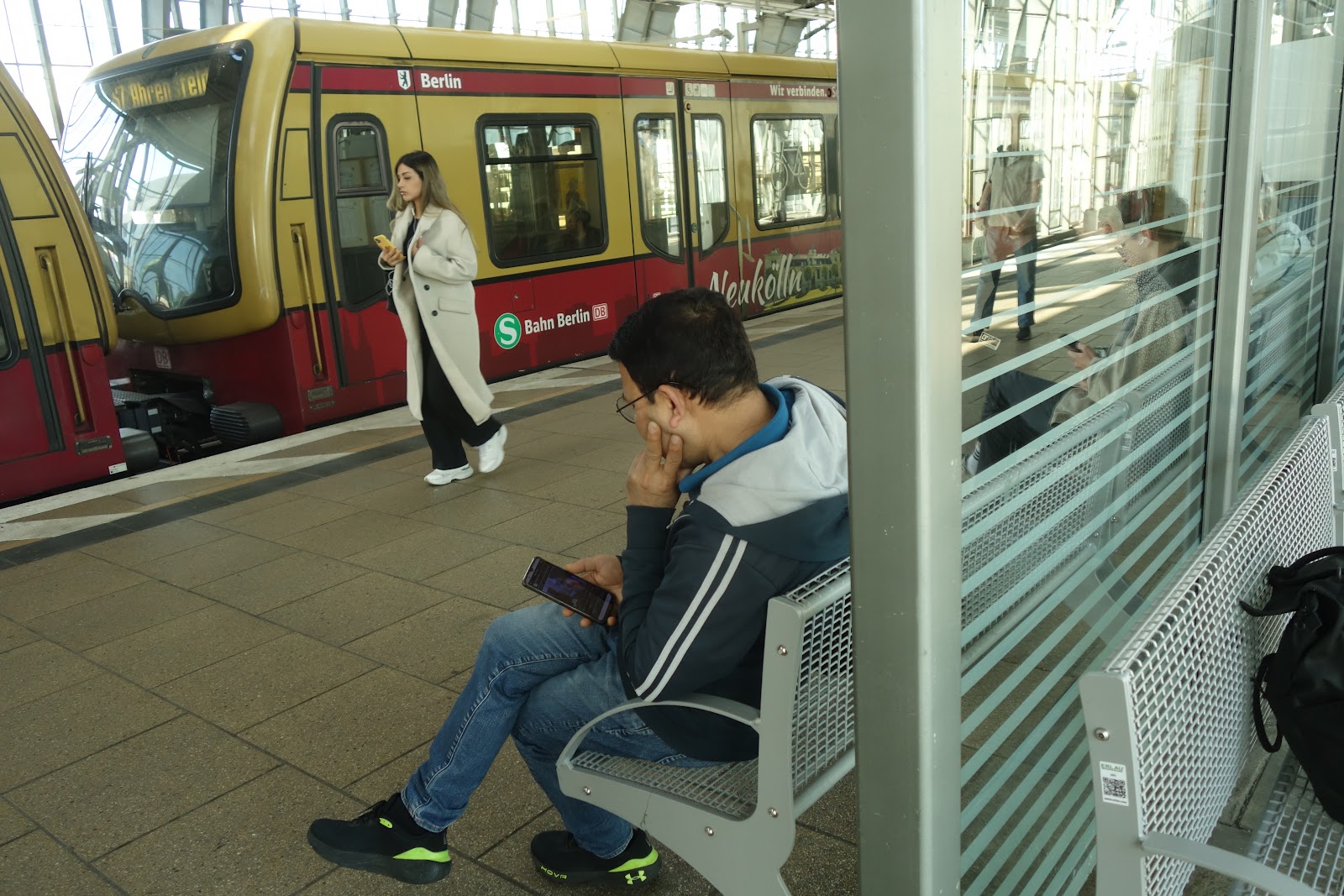
Station at Berlin  Alexanderplatz, the former center of the GDR

Isn’t it nice if you have a hotel close to that means of transport you selected to actually get there? People like to have their car in front of their hotel room. Or at least underneath. Well I would not like to stay next to an international airport or a motorway. However, I always try to select a hotel close to the station, best with a view of it. First of all, when I arrive by train, I don’t want to
carry my luggage for a long way since it always seems to be too heavy.. Second, it is nice to watch all those trains from your room and dream about more destinations.


Inside Alexanderplatz station


While other European capitals like London or Paris have terminal stations, Berlin has the Stadtbahn. It is the elevated railway line used by West-East long distance trains and the S-Bahn, the commuter railway network extending far into the surrounding countryside. My hotel room overlooks these rails on their graceful arches. Passengers from all those trains running East or West can look right into my window. Behind the tracks is a huge advertisement of a shopping mall displaying a naked lady. Sweet dreams assured.

View from my hotel room

However, I did not realize that it can be so loud. No way to leave the window ajar after going to bed. After 2 nights I know the type of train by the sound. When the window is closed it is OK. At least I sleep very well.


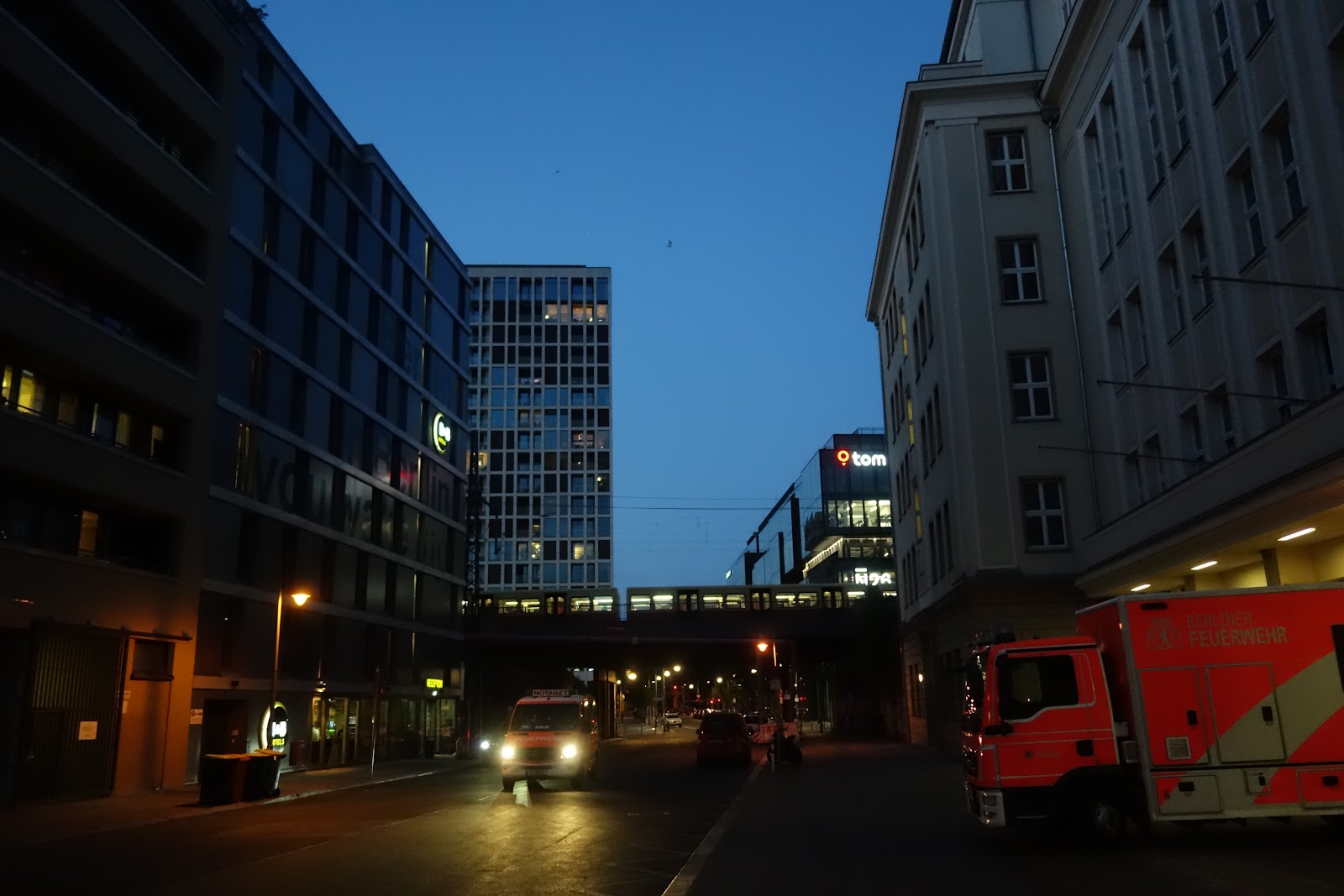
S-Bahn passing on the viaduct at night

To be frank: Besides the doubtful view of the graceful arches of the railway viaduct there is not much that would recommend that hotel. There is no comfy chair and no real reading light, no comfortable working space, no bar, no wellness, no restaurant, ….. There is not even a water glass or a bin. There always is a television. Why do they always provide a television. For free!


Office buildings in former East Berlin


The hotel is in the former eastern part of the city. While they have meticulously removed most traces of the former wall, it is remarkable that it is still immediately obvious after 30+ years on which side of the former border you roam. The patched cobbled streets have not changed, neither the sidewalks which are either unpaved and sandy or paved with slabs of big stone plates probably covering the sewer or some other infrastructure line. Around the corner a ruined church stands as a reminder of what was lost. Foundations of brick walls are actually the last remainders of the medieval city wall. There is more of it than of the famous communist Berlin wall. Huge 19th century classicist office buildings still look for a useful purpose.


Nowadays the front line is not a wall, or a checkpoint charly. Today the front line is on the road.


Cyclists trying to find their way

A Berlin friend of mine is an activist for the Berlin cycling association, They just booked a big victory by forcing the Berlin senator for traffic to resign. They found out that her thesis is a plagiarism. The question is why anybody would like to cycle in Berlin anyway without either being highly suicidal or phlegmatic. In both cases death is the likely consequence. My friends association places white bicycles in the city streets as memorials to cyclists killed in action. Around 180 white ghost cycles grace the town by now. Who wants to be next? When he unlocks his bicycle after we leave a pleasant lakeside restaurant at the Lietzensee an older guy asks us why we don’t use a car. He has a V8. It gives him erotic satisfaction.


The Funkturm built in 1926, one of the landmarks of Berlin (West)

My friend grew up in what was then the western part of the city. And he still sticks to this heritage more than 30 years after the wall fell. In former east Berlin he feels disoriented. It is not his world. When I ask him for a recommendation for a restaurant his answer is: forget it, it’s all loud and full everywhere. Too many people in this town, too many tourists., too much noise, too much traffic.


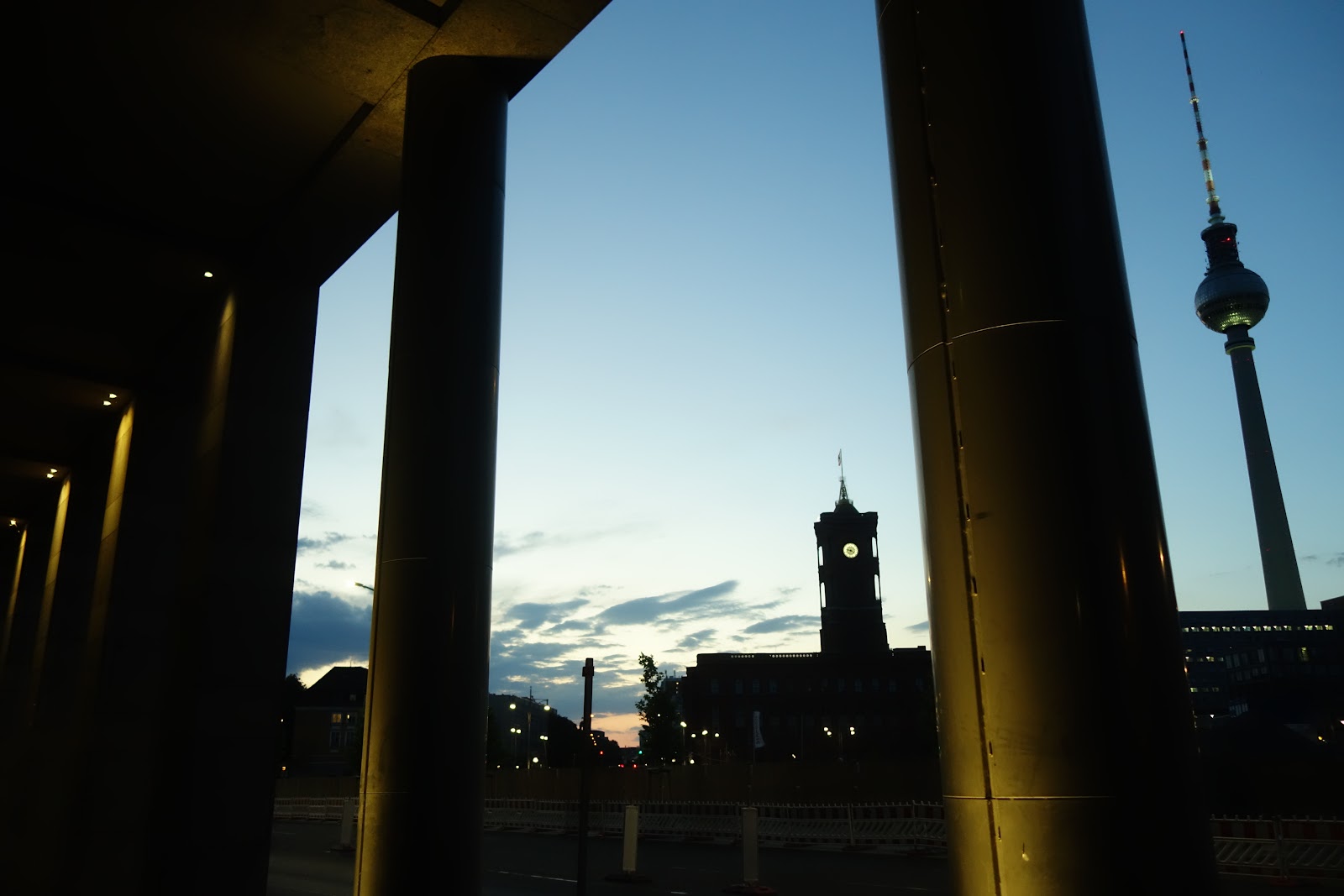
When the Funkturm waas lost to the western sectors of the city, the East answered by building the television tower at the Alexanderplatz

So I start walking along the Spree, the canal like river which is Berlin’s equivalent to the mighty Seine or Themse. It is pleasant and quiet. Trees provide some shade from the sun which is still strong in the evening. I pass a lock where a couple of excursion boats pass through. One is hosting a little party. It is fashionable and peaceful.


The Spree


A homeless man has set up his camp under a bridge. Tent (is it leaking, the bridge?), chairs, table and plastic bags. When I pass he is busy cleaning the ground around his belongings with a broom. In front of a fast food chain a bare chested, almost naked and heavily tattooed man is stretched out on the pavement. Nobody cares. Probably he was kicked down by the consequences of the food served in there. Joggers pass by, some taking advantage of the nice evening running almost naked. Only the number of empty beer bottles under the park benches bear witness that there might be other times as well.


The next stretch houses a number of restaurants at the water’s edge. I take an outside table covered in white table cloth and cutlery wrapped in napkins. I select an asparagus-maracuja soup as a starter. The fried liver with blue onions and mashed potatoes is one of the best I ever had. I top it off with a strawberry cheesecake and icecream.


Former center of the eastern part of the city, the red town hall

With each beer I get happier. It is all I wanted: it is quiet, the food is excellent and there is plenty of space.


Link to the next post: